6 Tips for Potty Training a Dog
Potty training a dog is a lot of work and can be frustrating and exhausting (with all that lack of sleep). It takes patience and consistency, but it is absolutely doable and necessary for the long-term happiness of both you and your pup.
Whether you’re training a puppy or an older dog to use the bathroom outside, these are six essential training tools that will help you and your dog in most situations:
1. Create a Potty Log for Your Dog
Being able to predict when your dog is going to next need to relieve themselves is the first essential step in potty training. Write down each time your pup urinates or defecates, including the accidents they have inside the house; it can also be helpful to note down each time you feed them.
Looking over the log, you’ll start to see patterns emerging for when they need to go throughout the day. These bathroom patterns can then be used to create a potty schedule.
2. Form a Bathroom Schedule
After identifying patterns in your dog’s potty log, you can start getting ahead of their accidents, ensuring they are taken outside on a schedule that fits their natural bladder and bowel rhythms. For example, if your pup has had a few accidents soon after their breakfast, make it a routine to take them outside immediately after they finish eating.
While this schedule will not assist with preventing excitable or anxiety-based accidents, the consistent act of bringing your dog outside for their regular bowel movements and providing lots of praise when you do will help emphasize that
3. Use a Crate
Among many other benefits, crate training can be incredibly helpful when housebreaking a dog. Like most animals, dogs do not like to ‘go’ where they sleep, meaning they will be much more willing to hold it while inside their crate.
When using a crate during potty training, make sure you head straight outside as soon as you let your dog out. Try carrying them if their outside potty spot is far enough that an accident could happen on the way! Choose a crate that is not too large and/or has an adjustable size as extra space can provide an additional bathroom spot for them within the crate.
It is imperative that you never use their crate as a source of punishment. This is their “safe space” and not a time-out zone. Always use praise and/or treats to encourage your dog into their crate while they are still adjusting and keep your tone of voice light and positive.
4. Choose a Command Word or Phrase
Try to pick a command word that they associate with urinating or defecating outside. Keep it simple with something like “Go Potty” or “Do your Business”. Repeat the potty phrase multiple times, every time they are successfully relieving themselves outside. Provide plenty of praise and/or a treat afterwards to help build the association.
This command word can be especially helpful when bringing your pup to new places where they don’t yet know the places that are/are not off limits. Using the command effectively tells your dog that the place they are in is an acceptable spot in which to relieve themselves.
5. Provide a Communication Tool for Your Dog
While some dogs are more obvious in their body language when they need to pee or poop (e.g., circling, sniffing around, whining, sitting by the door), others may not show any or enough warning. Providing your dog with a clear way to communicate their need to go outside can help trigger your attention much faster.
Placing a bell on or near the door you typically exit through, within reach of your dog, can be a helpful tool for many families with dogs. While training, it is important that the bell is rung every time you and your dog go outside for potty time, conditioning them to the idea that if the bell is rung, someone will come to let them out.
6. Use Positive Reinforcement
Remember that it is perfectly normal for puppies and older dogs with trauma to have accidents while they are still adjusting to their new home. They never have accidents on purpose and shouldn’t be punished for it; these pups simply lack control over their bladders and need consistency and patience from their human to help gain that control.
Do not put a dog’s face in their pee if they ‘go’ inside (this was a widely used technique in the past and has proven ineffective and emotionally stunting). Instead, provide a distraction away from the site, clean up quickly, and spray with a pet-specific odor eliminator to remove evidence of marking. Make sure to give lots of praise when they do go outside.
Situational-Specific Tips for Potty Training a Dog
Potty Training a Puppy
Due to their small bladder size and lack of urge control, housebreaking a puppy can be frustrating at first. Thankfully, since their brains (and bodies) are rapidly developing, the potty-training process tends to be faster than adult dogs.
When creating your puppy’s bathroom schedule, keep in mind that during the day most dogs can hold it a maximum of 1 hour for every month of age. The table below shows this in action.
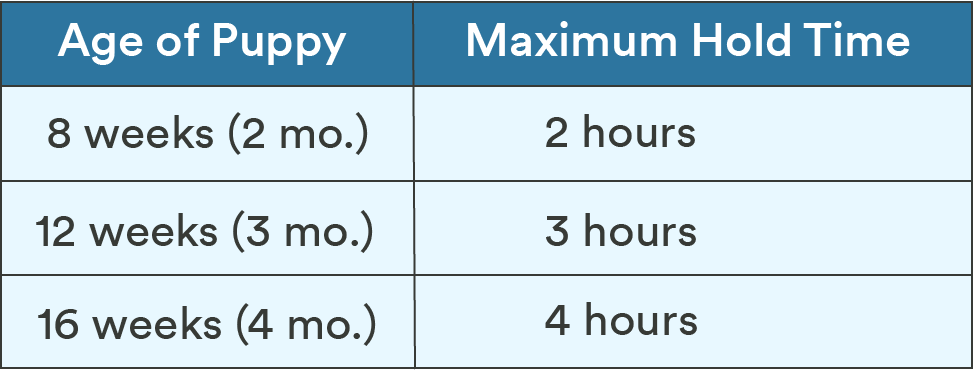
It is important to remember that this doesn’t mean they will hold it for these times, just that these are the max times a puppy can hold. So, when you have a 2-month-old puppy you should not be leaving them alone during the day for more than 2 hours before letting them out. When home, taking them outside every 45 minutes is usually the best option before you have developed a sense of their schedule.
When out and playing, puppies typically need to pee more frequently, and toy dog breeds also tend to require relieving more often than larger breeds. These factors should be kept in mind when forming bathroom routines for your puppy.
Potty Training an Older Dog
If you have adopted an older dog – congratulations! While rescue dogs can sometimes come with some unexpected challenges, they also bring hearts full of love and loyalty that they are just waiting to share with their new caring humans!
One of the most important things you can do to help housetrain your older dog is to develop and stay ridged to their daily routines. They may have experienced a lot of turmoil throughout their life, so having stability is key to building their trust – which is the foundation of any sort of dog training.
Bring them outside at set times throughout the day (e.g., as soon as they wake up, after each meal) and allow them time to sniff around. If they do not eliminate during this time, put them in their crate for 10 minutes before trying again. This will help them understand the purpose of this time outside.
If your dog is not used to grass or dirt (due to indoor confinement or concrete-only spaces in their past life), try having a friend’s well-natured dog come over. Seeing another dog using these areas of the yard can help show your pup that these areas are safe for relieving themselves too.
Potty Training a Dog in An Apartment
If you live in an apartment, you likely don’t have an outdoor safe space for your pup to potty train before they are fully vaccinated. In this case, you can use pee pads or pet turf mats on your balcony or even inside your apartment’s bathroom.
Once your puppy is fully vaccinated, bring the pee pads/ turf mats outside to the area in which your dog will be using to potty. Place these down in the area during your dog’s scheduled bathroom breaks (or when they signal the need to go) and use your designated command word. Since they have been rewarded for using these mats as their potty-spot, they will hopefully use them outside as well.
Over time, your puppy will begin to venture away from the pad/mat, smelling the scents of other dogs around. When this occurs, you can stop bringing the mats down to fully transition your pup!